
For sharing the project
Media and credits
Vulpes OS is an independent project created and mainly developed by OverSu to bring the spirit of Firefox OS back to life with today’s web technologies. Free and open source, it offers an Android preview; the native port remains experimental.
Logo and mascot


Nivi · The Arctic Fox of Vulpes OS
The official project mascot.
PNG illustration ↓
Keep the logo’s proportions, colours and surrounding space. Use the logo to identify the project and Nivi to accompany it; illustrations are not system screenshots. These files are provided to introduce Vulpes, without implying a transfer of trademark or component rights. For other uses, contact the project on Forgejo.
Visual artwork
Some illustrations and visual assets used by the Vulpes OS project, including selected artwork featuring Nivi, were created with the assistance of generative AI tools (LLM Ollama FLUX.1 Schnell 12B) under the project's creative direction. These illustrations are used for visual identity and communication purposes. The Vulpes OS software itself is independently developed and open source.
Vulpes on screen.
Two real screenshots of the desktop prototype, published on Forgejo. They show the interface, without claiming every app works.
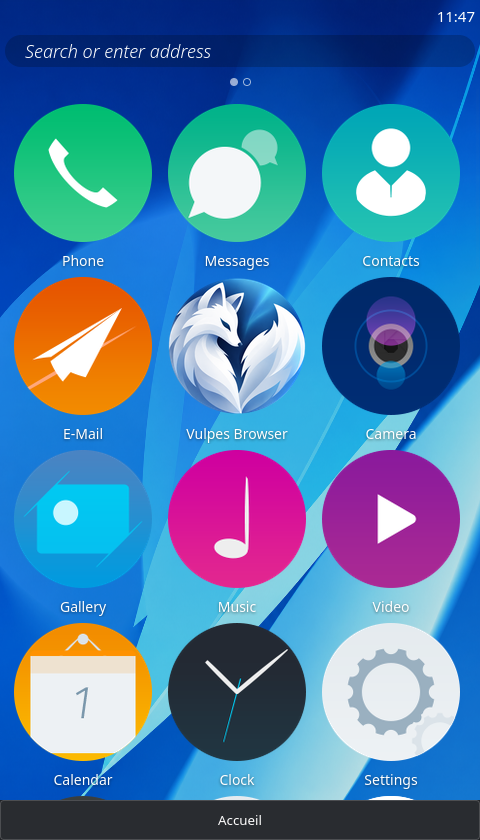
Linux prototype · Vulpes 2.7 · English interface
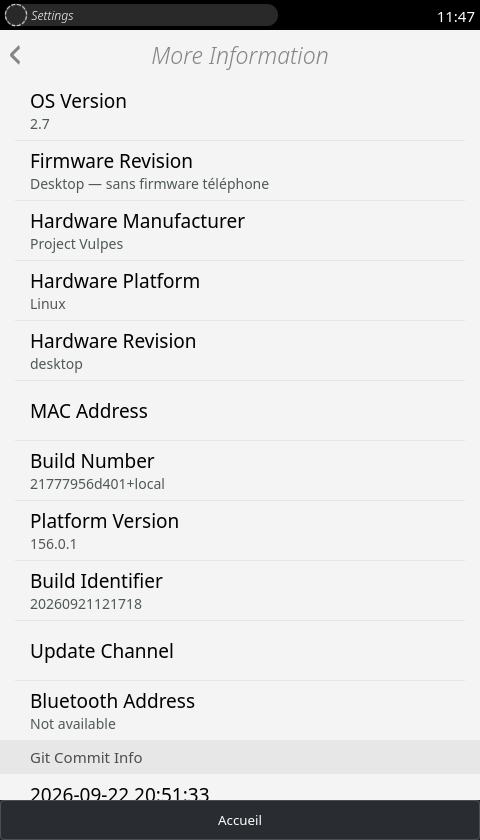
Linux prototype · Vulpes 2.7 · English interface
Source: public repository, accessed on 27 September 2026. The capture date is not specified, and the home screen’s exact build has not been confirmed. The information screen shows Gecko 156.0.1 and build 21777956d401+local. Forgejo ↗
Origins and attribution
Vulpes builds on the work of Mozilla and the contributors to Boot to Gecko, Firefox OS, Gaia and Gecko. Firefox, Firefox OS and their historical branding belong to their respective rights holders. The project is not affiliated with or endorsed by Mozilla.
Marketplace apps retain their original authors and individual licences. Archiving does not grant a blanket licence to redistribute or modify them. Each listing identifies its origin in the March 2018 capture preserved by Internet Archive.